
From Unsung Horrors Has Risen from the Grave, published 2024
When RKO hired Val Lewton to run its horror unit in 1942, its executives had fairly simple expectations: His films had to be cheap (no more than $150,000), short (just over an hour), and based on pre-approved titles like The Cat People and I Walked with a Zombie. As long as he stayed within those parameters – and made a profit, of course – the cultured, perfectionist producer could do pretty much as he wished.
The suits had no idea what they were in for. Lewton was a true auteur, and he hired directors who would fulfill his vision. He drew on art, literature, and folklore to offer audiences much more than cheap scares. He could handle that part, too, but it was never the point. His work was more in line with the film noir and social dramas of the era, with their challenging themes and dark aesthetics.
Fortunately, Lewton’s films made money, and he had supporters at the studio who appreciated his style. He produced 11 features for RKO between 1942 and 1946, nine of which were genre films. Bedlam was the last of the series, and it epitomizes the Lewton style, while eliminating its predecessors’ vague allusions to the supernatural. Here, the monsters are horribly, unmistakably human.
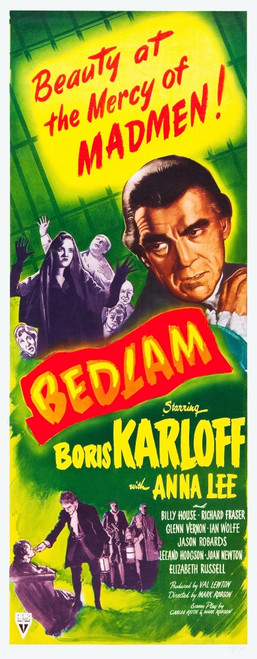
Bedlam marked the third collaboration between Lewton and Boris Karloff, who had grown tired of the increasingly formulaic material he was being offered at other studios (namely Universal, which was deep into “Monster A Meets Monster B” territory by this time). After The Body Snatcher and Isle of the Dead (both released in 1945), Karloff was ready to take on the scene-stealing role of Master George Sims, head apothecary of London’s Royal Bethlehem Hospital (better known as “Bedlam”) in the supposedly enlightened year of 1761.
The cruel, obsequious Sims is one of Karloff’s best villains, a man of humble means who has found a way to hover around polite society, while never being accepted into its ranks. He pinches pennies enough to please the bosses, and keeps his charges under control in their hellish prison. In return, Sims is allowed to put on the airs of an intellectual, fancying himself a poet and playwright who uses his patients as gruesome inspiration.
During one of these productions, a young man dies for Sims’ art, catching the attention of two important people, real-life reformer John Wilkes (played by Leyland Hodgson) and Nell Bowen (Anna Lee). Nell has also clawed her way up from the lower classes, and is now a companion to Lord Mortimer (Billy House), who finds her playful wit amusing, as long as she doesn’t cause too much trouble.
While she pretends not to be concerned for Bedlam’s inhabitants, Nell is in fact outraged at Sims’ actions. Only a sympathetic Quaker, Hannay (Richard Fraser), sees through her fake callousness, and his example inspires her to act on her concerns. Sims sees the threat Nell poses to his schemes, and he convinces Mortimer to have her committed to the asylum herself. Behavior that once seemed charming is turned against her, and the scene in which she’s condemned by a panel of disapproving men is as harrowing as anything inside Bedlam. She is trapped – by gender, social status, and the whims of her “betters” – well before her confinement actually begins.
Nell is one of several powerful Lewton heroines, ranking right up there with The Seventh Victim’s Mary Gibson and Betsy Connell from I Walked With a Zombie. All three are smart, determined women who refuse to be destroyed by the world’s evils, and Nell may be the most formidable of them all, thanks to Lee’s steely performance. She is terrified when Bedlam’s doors close behind her, swallowed up by the deep shadows and threats of violation, but her fear doesn’t last long. The bold intelligence that gave her everything, then took it away, becomes her weapon against Sims.
Lewton (under the pseudonym Carlos Keith) co-wrote the script with director Mark Robson, but the third creative force is the most unusual. Painter William Hogarth’s A Rake’s Progress is credited as the inspiration for the story, specifically the final panel, called “The Madhouse.” In it, a dissolute young man is committed to Bedlam, and Hogarth’s imagery is inserted at various points in the film, sometimes as depictions of his actual work, sometimes as posed tableaux within a scene.
That may seem pretentious in a low-budget thriller, but Lewton was always sneaking highfalutin ideas into his productions. Who else would make a zombie movie based on Jane Eyre? Bedlam’s carefully composed shots are rather stilted compared to the less-direct literary references in I Walked WIth a Zombie, but you have to give Lewton and his team credit for having this much ambition and the skill to achieve it.
Lewton and Robson aren’t just playing with artsy visuals. Every lost soul in the madhouse is a sympathetic character, something the audience learns right along with Nell. Sims allows some of the more lucid patients to socialize, and Nell readily falls in with them, chatting and playing cards in a near-parody of her old life. But thanks in part to Hannay’s influence, she can’t ignore the suffering outside their circle. When she takes pity on a caged so-called brute (pro wrestler Vic Holbrook), Sims is certain she’ll be attacked and learn the value of his cruel treatment. Instead, Nell’s kindness transforms the man, and Sims begins to understand just how much of a threat she really is.
Her fellow captives get it, too. When Sims threatens her with his most drastic “cure,” the unspecified – but clearly terrifying – threat leads the patients to revolt, giving Nell time to escape while they put their tormenter on trial. Karloff almost engenders sympathy for his vile character, as Sims tries to argue that he, too, is a victim of circumstance, with no real choice in his behavior. The inmates are largely unmoved (the “split him in two” guy is a scene-stealer), but they know that anything they do to him will come back on them tenfold.
Sims’ ultimate fate is chilling, and rather shocking for the time, as is the response from Nell and Hannay. In a place like Bedlam Asylum, even a man of God can’t afford moral certitude. It’s the kind of ending that can lead to discussions about the conflict between philosophy and the greater good – not something you’d expect from a year whose horror releases included Strangler of the Swamp and Devil Bat’s Daughter. But Lewton’s work always went beyond its B-movie roots, and it belongs in the pantheon of the era’s great “serious” cinema. – Loey Lockerby
 suchacritic.com
Leave a comment