From Euro Horror, published 2024
A title like Bloody Pit of Horror conjures up all sorts of gruesome imagery, especially when the filmmakers claim it’s based on the writings of the Marquis de Sade. Will there be dismemberments? Disfigurements? Rivers of the red stuff?
Not exactly. Even by 1965 standards, this exploitation flick is fairly tame – there’s more blood in the title than on the screen – but it has just enough loony creativity to make it a cult favorite. The shock metal band Gwar named an album after it, which must confer some kind of street cred. It’s also filmed in PsychoVision, whatever that means (probably nothing, but it sounds cool).
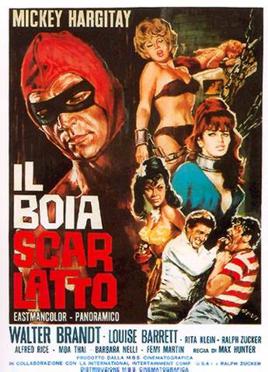
The original Italian title, Il Boia Scarlatto, is more apt (if less interesting), referring to the Crimson Executioner, whose own execution we witness in the opening scene. He’s a 17th century serial killer obsessed with morality, and the authorities lock him up in his own iron maiden, while placing a curse on his castle. Cut to the present day, when a group of idiots looking for a photo shoot location decide the place is perfect. Since no one answers the door, they decide to just break in, rationalizing the move as necessary since they’ve had no luck in their scouting so far.
A quick glance around the interior shows a clean, well-lit space that is obviously inhabited. Just as the intruders start to figure this out, a servant leads them to the owner, who is hidden behind a desk full of bric-a-brac. He tells them to get out, ignoring their whining about how long they’ve been on the road.
He changes his mind when he sees Edith (Luisa Baratto, going by Louise Barrett), who we later learn is his ex-fiancée. He says they can spend the night if they leave him alone and stay out of the dungeons. Naturally, they head straight for the dungeons.
This leads to the first bit of stylish weirdness, as photographer Dermott (Ralph Zucker) stages scenes for horror book covers. The poses are a mixture of cheesecake and bad drug trip, and director Massimo Pupillo (credited as Max Hunter) tries to make them comical. Intentional humor is not Pupillo’s strong suit, and the sequence only serves to fill out the running time. It does make one wonder about the content of those books.
Even with the extra material, the characters remain practically interchangeable. The books’ writer, Rick (Walter Brandi), is the ostensible hero, and there’s also the smarmy publisher (Alfredo Rizzo) and five models (Rita Klein, Barbara Nelli, Moa Tahi, Femi Benussi, and Nando Angelini), along with Dermott and Edith, who is notable mostly for keeping her clothes on. They are all rude, entitled, and thuddingly stupid, so watching them in “light” situations isn’t nearly as much fun as watching them suffer. The trespassing alone would get most movie characters killed. These people put their feet on the furniture!
The mysterious homeowner is played by former Mr. Universe Mickey Hargitay, who had entered the film industry via his wife, Jayne Mansfield (and is now best known as the father of Law & Order: SVU star Mariska Hargitay). By his own admission, he isn’t much of an actor, but he is charismatic and built like a Greek (or Hungarian) god. Those qualities go a long way in a film like this, where so little else of interest is happening.
Hargitay’s character, Travis Anderson, is a former star of sword-and-sandal movies, who went into seclusion because being around other people corrupted his flawless body. He explains this while oiling up and flexing for Edith, who is no longer impressed. She manages not to burst out laughing when he dons the Executioner’s ill-fitting costume, which makes him look like a discount-bin Mexican wrestler. Offended by his guests’ lack of purity, Travis fully takes on the killer’s identity and begins making use of his well-maintained torture chamber. Even Edith isn’t spared, as he no longer cares for any inferior human specimens.
There’s a hint of a theme here, as Travis’ obsession with physical perfection literally drives him insane. Pupillo and writers Romano Migliorini and Roberto Natale slip in a critique of the bodybuilding culture that was so much a part of Hargitay’s professional life. He had even starred in The Loves of Hercules in 1960, exactly the kind of peplum cinema Travis is known for. It’s hard to tell if this is meant to be serious, as it plays more like self-parody than anything else. Hargitay is at least a good sport about it, whatever the intention.
When Travis goes bonkers, Hargitay’s performance follows (maybe that’s what PsychoVision refers to). He bounces around the dungeon, delivering lines like “the Crimson Executioner invented the torture of icy water for creatures like you!” while laughing maniacally. Hargitay’s boundless energy compensates for his lack of thespian skill, although it makes the rest of the cast even more boring. He does seem to be having fun, which is a great part of the movie’s appeal.
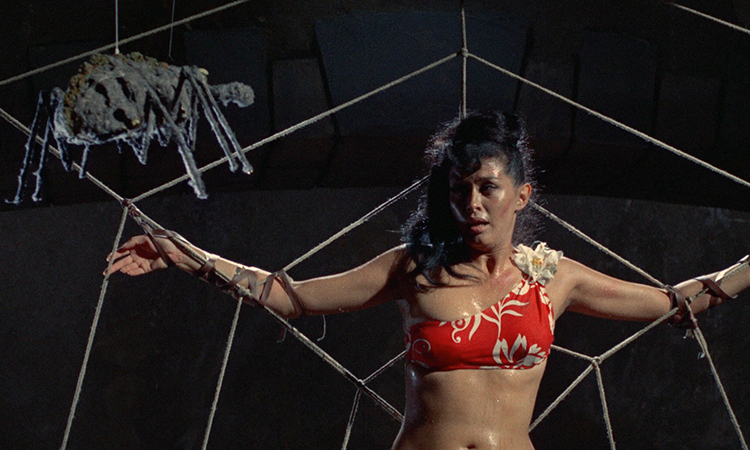
The audience is also treated to some inventive set pieces, particularly when it’s time for someone to die. Tahi’s character gets trapped in a giant fake spider web, complete with a giant fake spider moving slowly toward her, ready for the kill. The contraption is rigged to shoot arrows if the “web” is disturbed, so Rick has to crawl underneath it to rescue her. The setup is so elaborate, one can only assume it’s been built and waiting for a victim for centuries. Either that, or Travis has many more henchmen working for him than we ever see.
Another scene involves Dermott’s attempt to leave and alert the police. His convertible is shown from a distance, driving in circles. A close-up reveals his body leaning over the steering wheel, with an arrow sticking out of his neck. The shot proves that Pupillo at least has a decent visual sense, even if it’s not as over-the-top as some of the other deaths. The special effects are by Carlo Rambaldi, who would go on to an illustrious career, working on the likes of Alien (1979), E.T., the Extra-Terrestrial (1982), and Dune (1985). He isn’t required to do anything so elaborate for Pupillo, but he makes it look professional.
Later, Rick is tied to a bed while spikes slowly descend from the ceiling – slowly enough that he’s able to cut himself loose, thanks to the nail clippers in the pocket of the dead body conveniently lying next to him. He goes to beat up the aforementioned henchmen, who seem to have escaped from the old Batman TV series, then races to save his friends. Despite Rick’s valiant and reasonably clever efforts, only he and Edith survive. The other characters keep getting in the way of flying weapons, and you can’t rescue someone who doesn’t know how to duck. Even Travis suffers a clumsily ironic demise, stumbling into the “lover of death,” a dummy covered with poisoned barbs, designed to punish fornicators.
Bloody Pit of Horror was the second of three genre films Pupillo directed in 1965, before moving on to spaghetti westerns and television gigs. Terror-Creatures from the Grave (5 tombe per un medium) and Lady Morgan’s Vengeance (La vendetta di Lady Morgan) are both relatively subdued, black-and-white gothics. For this one, Pupillo goes right for the heart of tastelessness, filling the screen with bright (mostly red) colors and doing away with atmosphere and narrative coherence.
He slips in as much violence and near-nudity as he can without risking censorship, and if he can combine the two, so much the better. One of the Executioner’s devices gradually cuts away the clothes of two women until the blades reach their skin and start drawing blood. At other times, the ladies are bound, topless, to endure slow torments like hot coals and tar. Of course, the male characters are also killed, but their deaths are not as drawn-out – and certainly not as sexualized – as the women’s.
In almost every way, Bloody Pit of Horror is typical of the era’s low-grade Italian fare. It was shot at the Palazzo Borghese in Artena and the Castello Piccolomini in Balsorano, so it has the authentic look available in a country full of very old buildings whose owners could use a little cash and publicity. The dubbing is as bad as the acting, and there may never have been a consistent script, let alone a decent one. Simply identifying everyone involved is a challenge, since most are credited under anglicized pseudonyms in an attempt to make the film more marketable in the U.S.
And yet, Bloody Pit of Horror still manages to stand out. Maybe it’s the wild death scenes. Maybe it’s Pupillo’s moments of inspiration. Maybe it’s the false hope offered by the title. Most likely, it’s all of the above, elevated to glory by a crazed muscleman in a silly outfit, making sure no one ever forgets the Crimson Executioner. – Loey Lockerby
 suchacritic.com
Leave a comment