From Euro Horror, published 2024
When The Exorcist was released in 1973, evangelist Billy Graham reportedly insisted that “the Devil is in every frame of this movie” and evil is “buried within the celluloid of the film itself.” To Graham, it wasn’t just scary – it was infected, endangering the very souls of the people who watched it.
Sounds like a great plot for a horror film.
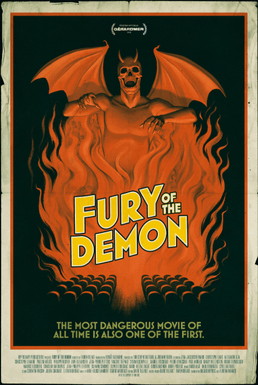
The concept turns up pretty regularly in print, in books like Marisha Pessl’s Night Film and Ramsey Campbell’s Ancient Images and The Grin of the Dark. For some reason, it is surprisingly rare in the very medium it represents. The TV series Masters of Horror and American Horror Stories have featured episodes with cursed films, and the Ring series has its notorious videotape. But one of the cleverest uses of the trope is among the least known. The 2016 French mockumentary Fury of the Demon (La rage du Démon) goes back to the beginning of cinema, incorporating the real story of pioneering fantasy director Georges Méliès into a tale of occult mayhem. It’s not quite seamless, but it’s close enough to be almost convincing.
Writer-director Fabien Delage specializes in blurring the line between fantasy and reality. He helped create the popular series Dead Crossroads, in which he stages investigations of “haunted” buildings in France, and has directed the found footage titles Cold Ground (2017) and a segment of 3:15 am (2018). He is also a photographer, typographer, musician, and silent cinema expert who works on the preservation and restoration of early classics. It’s hard to imagine anyone more suited to a project like this.
The structure is the same as any dry talking-head doc, albeit one with a dark twist. Interviewees include real historians and filmmakers, who recount their excitement over a 2012 screening of Fury of the Demon, a long-lost film presumably directed by Méliès. No one had heard of it or met the collector presenting the screening, but that’s not unusual in a world where random people routinely find unlabeled reels in someone’s attic.
The thrill of enjoying a rare work of art is short-lived, as the viewers become inexplicably enraged, attacking each other and causing bloody chaos in the theater. When the violence settles down, both the film and the collector are nowhere to be found. Similar incidents are recounted, from the film’s original release in 1897 and a special showing in 1939, although these tragedies have received very little media attention, at the time or decades later.
That’s the first clue that this is all fictional, as any self-respecting cinephile – especially a horror fan – would have heard about this, even if it was dismissed as an urban legend. Someone definitely would have found and posted video of the 2012 screening. There are still people who think a ghost lurks in the background of Three Men and a Baby, no matter how many times the story has been debunked. Nothing fades away in the Internet Age.
But that’s not the point. It’s clear that tricking the audience isn’t Delage’s purpose, just as it wasn’t really Méliès’. Both enjoy bringing viewers into their constructed realities, always giving a little wink to acknowledge that everyone is in on the ruse. This was part of Méliès’ ethos as a stage magician, and his imaginative playfulness found ideal expression in cinema. He was the first director of fantasy, science fiction, and horror, making films that retain their ability to entertain and amaze over a century after their creation. No offense to Thomas Edison or the Lumiére brothers, but nobody watches Blacksmithing Scene or Baby’s Dinner for fun anymore, no matter how cute little Andrée Lumiére was. Put on A Trip to the Moon, however, and it’s impossible not to smile at the famous image of an annoyed man-in-the-moon with a rocket stuck in his eye. No other film from 1902 is still that recognizable, for good reason.
Méliès’ forays into horror understandably get the most attention in Fury of the Demon. Evil spirits figured regularly into his work, with Satan himself appearing several times. The surviving footage is more humorous than anything, but it still has an air of mystery. Like most early films, these often lack acting credits and have few intertitles, causing uncertainty about just who we’re watching and what they’re up to. Delage takes this to its logical conclusion: What if Méliès was tinkering with real magic and unleashed something dangerous? And if he did, how can modern researchers determine exactly what happened?
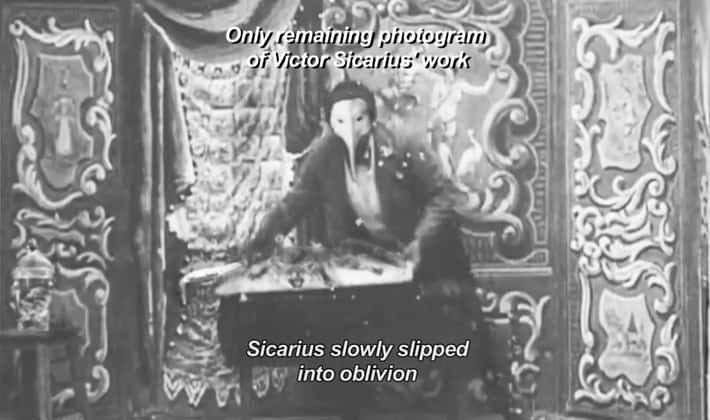
This is when Delage introduces Victor Sicarius, a supposed genuine occultist and spirit photographer who befriended Méliès and made knock-offs of his work. This kind of plagiarism was common at the time, as copyright law was in its infancy, especially regarding film productions. Directors routinely imitated each other shot-for-shot – even Méliès remade some Lumiére titles when he first started out. Delage’s experts hypothesize that Fury of the Demon may have been produced by Sicarius, whose disturbing imagery and affinity for the dark arts made him too intense for his mentor and led to a falling out. Sicarius is later connected to the death of an actress and suffers his own tragic demise.
Sicarius is as fictional as the film he supposedly directed, and Delage’s unconvincing attempts to insert him into historical photos is a blatant giveaway. It’s very possible that the amateurish Photoshopping is intentional, another nod to the fakery inherent in the whole business. This isn’t really a story about demonic cinema, after all. It’s about the investigative work of historians and preservationists, as they spend countless hours poring over the brittle frames of films almost no one will ever see, or ever care to. If adding references to possession, Nazis, ritual sacrifice, and ergot poisoning is what it takes to get people interested in this esoteric subject, then more power to Delage and his collaborators.
Directors Alexandre Aja and Christophe Gans are among those who gamely share screen time with actors playing journalists, moviegoers, and the like, and all of them give convincing faux interviews. Even the great man’s great-great-granddaughter, Pauline Méliès, joins the fun. She seems happy to indulge in her family’s legacy of cinematic trickery, even in this somewhat muted form. The only subject who seems entirely unreal is academic André Puiseux, who wields a lit cigarette in a room full of old celluloid. If he’s a real person, he’s probably burst into flames by now.
Fury of the Demon isn’t the only Méliès-related film to come out in the 2010s. Martin Scorsese’s Hugo (2011) is an equally fond tribute with an entirely different tone, based as it is on a children’s book, Brian Selznick’s The Invention of Hugo Cabret (2007). It’s a sweet, melancholy fantasy that brings the Méliès classics to life in 3D, probably the best artistic use of that technology to date. Scorsese’s own dark impulses are nowhere to be found in his love letter to invention and discovery. It approaches Méliès with pure, reverent joy.And yet it makes a fitting companion piece to Delage’s film. Both directors want to generate appreciation for Méliès’ work and the efforts to preserve it. Scorsese does so by shining a warm light, while Delage gazes directly into the abyss. Both approaches effectively illuminate their subject’s work, which says everything about the versatility of Méliès’ genius. That’s something no one could ever fake- Loey Lockerby
 suchacritic.com
Leave a comment