From The Blood Is the Life, published 2024
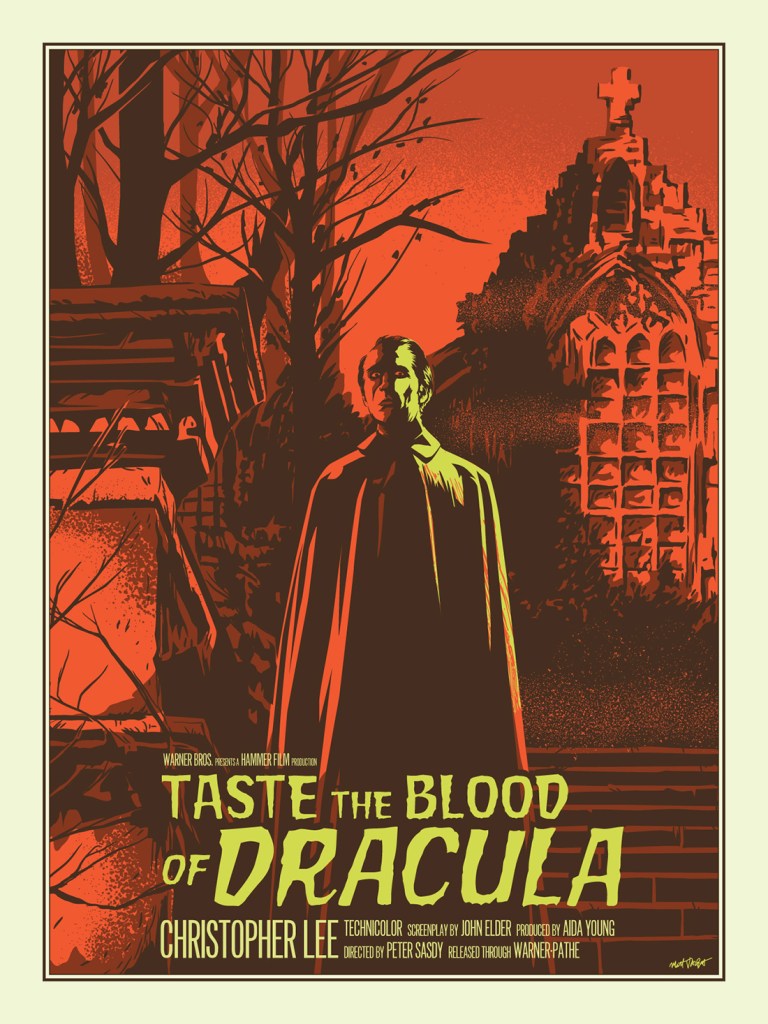
There’s a whole subgenre of great horror movies with stupid titles. Let’s Scare Jessica to Death (1971) is a first-rate psychological thriller with a paranormal twist. I Walked with a Zombie (1943) is the greatest zombie tale of the pre-Romero era. And 1970’s Taste the Blood of Dracula is the second-best film featuring Christopher Lee as the inimitable bloodsucker.
The best, of course, is the original 1958 Hammer outing, and it was a case of diminishing returns after that (literally in the case of Brides of Dracula, which didn’t feature the character at all). The studio’s fifth effort updates and revitalizes the formula, speaking directly to the era’s generational conflict without skimping on the old-school atmosphere.
It does skimp a bit on Dracula himself, thanks to Lee’s reluctance to continue the series. Anthony Hinds (using his usual pseudonym of John Elder) produced a screenplay that replaces the Count with a human acolyte, but Warner Bros. refused to release any Dracula title without its biggest star. Backed into a corner, the studio paid Lee his asking price and brought him into the story. The final product keeps Lee in the background, and the challenge for director Peter Sasdy is to make him frightening from a distance.
The opening sequence has curio dealer Weller (Roy Kinnear) witness Dracula’s demise from Dracula Has Risen from the Grave, then sneak over to gather up his effects, including a large amount of dried blood. This is the last time Hammer would bother connecting Dracula’s death in one film directly with his revival in the next. It’s a solid beginning, despite the many logistical questions it raises, not least of which is how Weller avoids being seen by the previous movie’s heroes. It seems unlikely that they’d just leave all that stuff lying around.
The action then moves to London, where three pious families are leaving a church service. They are led by patriarchs William Hargood (Geoffrey Keen), Samuel Paxton (Peter Sallis), and Jonathon Secker (John Carson). Secker’s son Jeremy (Martin Jarvis) is in love with Paxton’s daughter Lucy (Isla Blair), and Paxton’s son Paul (Anthony Corlan) is romancing Hargood’s daughter Alice (Linda Hayden). Alice and Lucy are best friends, and everyone is perfectly nice and respectable.
The kids and their mothers are, anyway. Sasdy flips the narrative immediately, showing the teenagers as the decent, caring ones, while their fathers turn out to be anything but. The three “gentlemen” make regular visits to a brothel in the poorest part of the city, but are increasingly bored with such prosaic debauchery. Enter Lord Courtley (a wildly overacting Ralph Bates), who has been disowned for performing a Black Mass in the family chapel. Intrigued by Courtley’s confidence and promises of unearthly delights, the men help him purchase Dracula’s remains from Weller and attempt a resurrection.
The desecrated church they use for the ritual is a terrific, ominous-looking set. It was designed by Scott MacGregor, who took over from Hammer stalwart Bernard Robinson, and it’s full of dark corners, crumbling stone, and appropriate Satanic accoutrements. It looks like the kind of place where very bad things belong, and there’s an oppressive weight to it that even Bates can’t chew through, try as he might.
The whole business ends badly, with Courtley drinking Dracula’s reconstituted blood and the others freaking out and killing him in response. They decide to leave the corpse and pretend nothing happened, but the Count is still brought back to life. He somehow replaces Courtley’s body with his own, in a scene that screams “hastily rewritten because our star came back”. Why bother explaining your original villain’s disappearance when you can just…not?
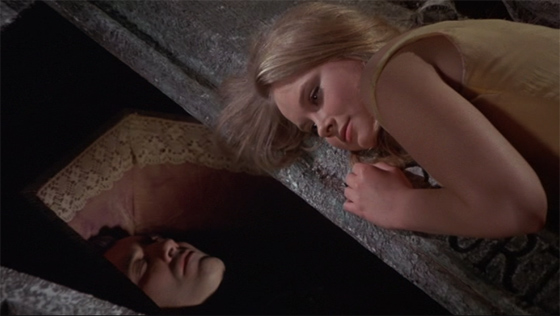
Dracula is quite displeased about the death of his servant and, per usual, seeks revenge by seducing his enemies’ women. Instead of going for their wives, he heads straight for Alice and Lucy. Alice is especially open to the idea, since her father is the absolute worst. Hargood is a mean drunk, and his concern about the activities of his “sexually mature” daughter seem more predatory than paternal. Once he turns violent, it doesn’t take much supernatural influence for Alice to smash his head with a shovel.
Alice lures Lucy into Dracula’s embrace, and he chooses to turn her into a vampire while keeping Alice as his living servant. This leads to a horrific sequence in which Paxton finds his daughter in her coffin. He is the least terrible of the old men, and overwhelmed with grief and guilt at what his hedonism has wrought. Naturally, he can’t bring himself to stake his own child, but Lucy and Alice have no such scruples about him. Their vicious attack is among the most gruesome and disturbing scenes in the entire Hammer canon.
That leaves Secker, the intellectual of the group. He has just enough time to research and write down what’s happening before Jeremy goes under Dracula’s spell and takes him out. Paul – who has inexplicably been spared – reads Secker’s letter and uses the information to prepare for battle.
Taste the Blood of Dracula was released in 1970, as the counterculture of the ‘60s was taking a decidedly grim turn. Riots, assassinations, and bombings were all over the news. The 1969 Manson Family murders gave disturbing resonance to the story of a madman convincing youths to commit atrocities. While the generation gap metaphor was apparently intended, Sasdy could not possibly have known just how on-the-nose this plot would be.
The relative lack of Dracula works in this context, as Lee looms menacingly while observing his handiwork (has anyone ever looked better in a long cape?). The character’s original dialogue was even worse than usual, and Lee refused to say most of it, making notes in his script like “Ridiculous lines” and “NO”. Sasdy was considerably younger than the series’ previous directors, and he was open to taking a new approach, making Dracula more of a puppetmaster than an active player.
Lee’s frustration over the writing was likely compounded by his recent completion of El Conde Dracula, a proposed attempt by Spanish director Jess Franco to make a version more faithful to Bram Stoker’s novel. Lee was excited about the project, and it does get closer to Stoker’s work in some ways. But it is still a Jess Franco movie, produced by exploitation maestro Harry Alan Towers, so it doesn’t exactly live up to its promise. In the case of Taste the Blood of Dracula, moving further from the source makes for a more interesting adaptation.
This one also has one of the better Hammer casts. Some reviewers have praised Bates for his over-the-top performance, so your mileage may vary on that one. But Keen, Carson, and Sallis bring the maturity of experienced actors to the early scenes, with the younger performers acquitting themselves well when they take over. Hayden was only 16 during production, and her turn from frightened innocent to gleeful murderer is particularly chilling. Her next screen appearance would be as the demonic teen seductress in Blood on Satan’s Claw, which feels like a natural progression.
Lee was born to play Dracula – whether he was happy about that or not – and he proves you don’t need much screen time to dominate an entire film. Like the shark in Jaws, his presence is a constant threat, and when he does show up, it packs a bigger punch. After the resurrection scene, his inclusion is fairly seamless, considering how the script evolved.
At least until the end. After Paul reconsecrates the chapel and Alice snaps out of her trance, Dracula tries to escape, but is trapped by all the religious paraphernalia. There’s no sunlight, no staking, no barrier of running water – just the Lord of the Undead looking scared and falling down. He lands on the altar, turns to dust, and that’s that. It’s a confusing and ignominious way to go, but like the silly title, it can’t ruin what is an otherwise high point in the series. – Loey Lockerby
 suchacritic.com
Leave a comment