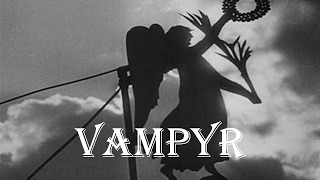
From The Blood Is the Life, published 2024
Can a film be both behind the times and ahead of them? Carl Theodor Dreyer’s Vampyr is an acknowledged masterpiece now, but its release in May of 1932 was a disaster. Panned by critics and booed by audiences, Vampyr could not escape the expectations set by Universal Studios’ Dracula and Frankenstein, which had been massive hits the year before. Dreyer’s style was just too weird for mainstream crowds.
To find a true stylistic peer, you have to go back to Luis Buñuel’s avant-garde Un Chien Andalou (1929) or forward to Maya Deren’s dream-logic short films of the 1940s. Technically, Vampyr has a linear story, but it feels like an afterthought, something Dreyer attached out of necessity but had little interest in.
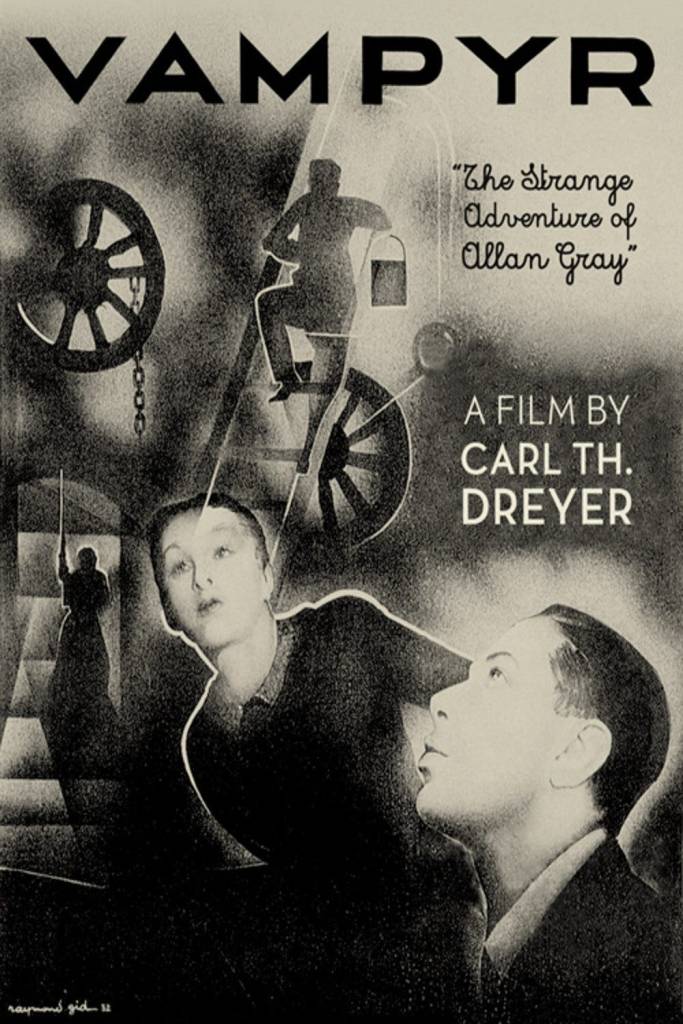
The protagonist, Allan Gray (called David in some versions and Nikolas in the script), is described as a man whose study of the supernatural has made him a “dreamer,” an immediate clue that we can’t trust everything we see. His wanderings take him to the French village of Courtempierre, which seems to be made of ghosts. Shadows move independently, inanimate objects become animate, strange noises have no apparent source. Even the flesh-and-blood locals are inscrutable, rarely behaving in ways one might call normal. A mysterious man (Maurice Schutz) appears in Allan’s room late one night, bearing dire warnings and a package, and the only way Allan (or the viewer) knows this really happened is because the package is on the table the next day.
The man is Der Schlossherr (meaning Lord of the Manor) whose daughter, Léone (Sybille Schmitz), is wasting away from an unknown ailment. The Lord (who is never named) is killed, seemingly by a disembodied shadow, and Allan discovers that the package contains a book about vampires. It helpfully describes all of Léone’s symptoms and provides information on Marguerite Chopin (Henriette Gérard), an elderly Courtempierre woman who was once suspected of being a vampire. Along with Léone’s sister, Giséle (Rena Mandel), and a quick-thinking servant (Albert Bras), Allan pieces together Marguerite’s plan to prey on Léone with the help of the family doctor (Jan Hieronimko).
There are very few professional actors in the cast, and only Schutz had any significant on-camera experience. The standout performance comes from the 22-year-old Schmitz, in only her third film role. Léone is a suffering innocent, desperate for release, but she is also on the verge of being taken by an evil force. In one startling sequence, she gives her sister a vicious, hungry smile that borders on the obscene. Giséle understandably flees the room, as Léone glares at her like a predatory animal denied its mid-day meal.
No one else is quite as effective, in part because Dreyer was always looking for interesting faces instead of seasoned performers. Hieronimko was a Polish journalist and academic, discovered on a train in Paris. Mandel had done some modeling. Gérard was reportedly the mother of a cast or crew member. They all have terrific presence, but are not called upon to do much dramatic heavy lifting.
The most important non-actor in the cast is Nicolas de Gunzburg, who plays Allan under the pseudonym Julian West. Gunzburg was a young French-born aristocrat who offered financing in exchange for the lead role. He had no thespian ambitions, just a love of the movies and a dilettante’s willingness to dabble in whatever interested him. Gunzburg later became a prominent fashion magazine editor, mentoring the likes of Bill Blass and Calvin Klein, and he cuts a stylish, elegant figure even in his twenties. Allan is a perfect blank canvas for Dreyer’s art, a stand-in for the confused audience watching the madness unfold.
Even at his most dynamic, Allan is an observer, detached from his surroundings. It’s appropriate that the most famous passage from Vampyr involves him seeing his own dead body, before switching to the corpse’s point of view. Allan sees the doctor and Marguerite peering at him through a coffin window, then he is carried away to the cemetery. What could be more useless than a trapped hero being delivered to his own grave, helpless in the face of evil?
This bit is just Allan’s nightmare, although it’s barely distinguishable from “real” events. Once the vampire and her minions are destroyed, Dreyer implies that the surviving characters are safe from all those dancing shadows – the last scene unsubtly shows Allan and Giséle walking out of a dark forest into the light. It’s one of the rare moments featuring Dreyer’s trademark religious imagery, although he apparently cut more obvious references, like Marguerite recoiling from a cross-shaped shadow. It’s a far cry from his explicitly spiritual work, like The Passion of Joan of Arc (1928) or Ordet (1955), but suffering, rebirth, and redemption are still prominent themes.
The script, which Dreyer co-wrote with Christen Jul, is ostensibly based on J. Sheridan Le Fanu’s 1872 short story collection In a Glass Darkly. That book contains the classic novella ‘Carmilla,’ with its female vampire and besieged aristocrats, as well as ‘The Room in the Dragon Volant,’ which features a character who narrowly escapes premature burial. These casual similarities are Vampyr’s only connection to Le Fanu’s work, or any other inspiration. In every significant respect, this is an original story.
Vampyr was shot on location, largely for budgetary reasons (constructed sets were more expensive). The manor house is the Château de Courtempierre, a 14th-century castle which doubled as lodgings for the cast and crew. Other structures are abandoned or in ruins, and the settings enhance the feeling that reality and fantasy have blended into something uniquely unsettling. The village may technically be inhabited, but every space is as lifeless as the undead creatures that haunt it.
Cinematographer Rudolph Maté had worked with Dreyer on The Passion of Joan of Arc, and went on to a highly successful career in Hollywood. There’s a hazy, even blurry quality to many of the visuals, which began as an unintended side effect of shooting in natural light. Dreyer liked the look so much, he had Maté place a gauze in front of the camera to replicate it throughout. Maté’s camera work is restless, often moving and changing perspectives in counterintuitive ways. He and Dreyer never let viewers get their bearings, making it difficult to tell where structures – and even rooms – are located in relation to each other. The visual language of narrative film was well established by this time, and Dreyer and Maté constantly, deliberately undermine it. No wonder people found it off-putting.
Although it uses intertitles like a silent movie, Vampyr does have a musical score and spoken dialogue, along with those mysterious offscreen noises. The sound feels detached from the imagery, as Dreyer was making the film in three different languages for European and American markets. The actors had to mouth their lines in German, French, and English, while all the actual audio, including their voices, was recorded in post-production.
Syncing the dialogue proved challenging, especially when the German censors got involved. The doctor’s death scene and the destruction of Marguerite’s body were deemed too graphic, and it took creative editing to trim the offending content without ruining the carefully constructed soundtrack. This leads to jarring cuts and even more odd sound effects. Once again, an occurrence outside Dreyer’s control added to the creepy atmosphere. Vampyr exists in a kind of limbo between the silent and sound eras, using techniques from both without ever fully integrating them.
This sense of not belonging in any cinematic space gives Vampyr its lasting resonance, as well as its ability to frustrate. Viewers expecting a standard narrative or a full-blown experimental piece were – and will be – disappointed. But anyone prepared to wander through Dreyer’s dreamscape will understand why it became a venerated part of the horror canon. – Loey Lockerby
 suchacritic.com
Leave a comment