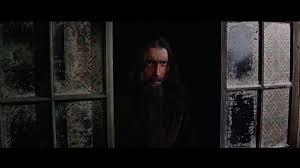
From Mods & Shockers, published 2025
Rasputin: The Mad Monk is only horror by association. It’s not scary and has no supernatural elements, but it was produced by Hammer Films, stars Christopher Lee, and was shot back-to-back with Dracula: Prince of Darkness. It could have been about fluffy teddy bears and the distributors still would have double-billed it with The Reptile.
Historical thriller is a better genre description, if you use a very loose definition of historical. Grigori Rasputin was, of course, a real person, a Russian mystic who insinuated himself into the court of Tsar Nicholas II in the early 1900s. His life (and eventual assassination) has been shrouded in mystery, and subject to endless speculation, ever since. For writers and filmmakers, this offers an irresistible opportunity. Did he really have healing powers? How did he actually die? Was he a conniving opportunist or an unfairly maligned patriot?
When production on Rasputin: The Mad Monk began in 1965, accurate information was hard to come by, thanks to the Soviet Union’s secrecy. Hammer’s heavily fictionalized approach is based on what limited (probably apocryphal) information was available, filling in blanks with plenty of creative license. There were practical concerns, too, as one of Rasputin’s killers, Prince Felix Yusupov, was still alive and fond of suing anyone who dramatized the story in a way that displeased him. This necessitated renaming and rewriting nearly all the characters.
In his autobiography, Lee recounts a brief childhood meeting with Yusupov and fellow assassin Grand Duke Dmitri Pavlovich, a coincidence which may have helped motivate the actor, who studied intensely for his title role. Co-star Francis Matthews later recalled Lee bringing stacks of books on the subject to the Dracula set for the cast to study.
Lee considered this one of his most challenging roles, and it is certainly among his best. His customary aristocratic reserve is nowhere to be found, as he throws himself into Rasputin’s hedonistic rampages. He doesn’t enter a room; he assaults it, slamming doors and shouting, seemingly about to break everything in sight. No mere building can contain him.
Rasputin first appears at a country inn, where the proprietor’s wife is dying of a high fever. After healing the woman, he demands a party, which ends with him assaulting the innkeeper’s daughter and slicing off her boyfriend’s hand. In this sequence, writer Anthony Hinds (using his John Elder pseudonym) tells us everything we need to know about his version of Rasputin. He seems to have genuine healing abilities, which he offers freely and attributes to God. He’s also a lecherous thug. When he is hauled before a Bishop to answer for his behavior, he defends even debauchery as an act of faith. If confession and repentance are essential to Christianity, then why not make them worth something? He intends to offer the Almighty “sins worth forgiving.”
There is ample opportunity for sin in St. Petersburg, where his drinking and dancing catch the attention of some slumming aristocrats. After taking over the apartment of an alcoholic doctor, Boris (Richard Pasco), Rasputin gains influence in the royal household by seducing Sonia (Barbara Shelley), a lady-in-waiting to Tsarina Alexandra (Renee Asherson). After saving the life of the young Prince Alexei, he earns the tsarina’s confidence and a place among Russia’s elite.
This doesn’t sit well with those already in power. Sonia is literally under Rasputin’s spell, hypnotized into doing his bidding and literally tossed aside when she is no longer useful to him. When her obsession comes to a tragic end, her outraged brother (Dinsdale Landen) soon discovers how ruthless this “holy man” can be.
Their friend Ivan (Matthews, in the not-quite-Yusupov role) conspires with Boris to stop this madness once and for all. Promising a date with Ivan’s sister (Suzan Farmer), they lure Rasputin to an apartment, where Boris has set out poisoned wine and chocolates. Never able to resist an indulgence, their victim enjoys his treats, but the poison isn’t strong enough to finish him off. The clean, carefully planned murder turns into a clumsy physical confrontation, and one of history’s greatest villains gets heaved out a window to his death. And then everything just…stops.
Given the legend that Rasputin was virtually unkillable, his demise is anti-climactic, to say the least. Various versions of the true story involve poison, shooting, beating, and drowning. Here, it’s just poison, a few punches, and gravity. No one has a problem giving the character actual mesmeric and healing powers, but a superhuman constitution is just too much.
Some of this is no doubt due to Yusupov’s litigiousness, but according to Matthews, a much longer fight was filmed. There are other segments that could have been trimmed without hurting the story, so why cut what is arguably the most important part? It’s a great scene as it is – Lee is nearly demonic in his strength and fury – which makes the abrupt ending doubly frustrating. The break-up fight with Sonia is more brutal and dramatic.
Director Don Sharp had some experience with both low-budget cinema and the Hammer style. He directed Kiss of the Vampire (1963) and The Devil-Ship Pirates (1964, also starring Lee) for the studio, and teamed with Lee again for a couple of the Harry Alan Towers Fu Manchu movies. He certainly has no problem pushing boundaries in the sex-and-violence department (we see that lopped-off hand close up, and later get a glimpse of Shelley’s bare back).
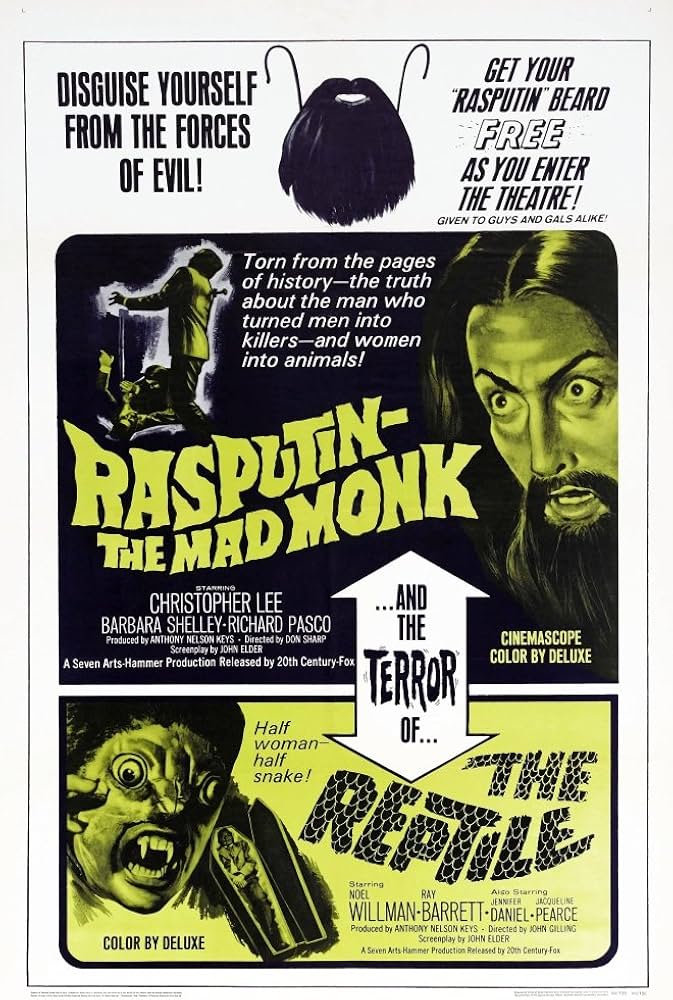
Rasputin: The Mad Monk was part of a hastily-produced four-pack of films the studio wanted to push out as double features (this one with The Reptile, Dracula: Prince of Darkness with Plague of the Zombies). Sharp handles the cheap rush job skillfully, and he has a particularly good eye for shot composition. There’s a suspenseful scene that takes place in near-total darkness, with the light only coming on at the end to reveal something gruesome.
The gruesomeness is the handiwork of make-up artist Roy Ashton, one of several Hammer stalwarts who could stretch limited resources into something impressive. Don Banks’s score is among better ones not composed by James Bernard, providing a rich orchestral background without being too obtrusive. Also on board are costumer Rosemary Burrows and production designer Bernard Robinson, who are rightly lauded as MVPs by fans and co-workers. The Dracula sets are obviously the Dracula sets, but Robinson redecorates them beautifully, and the costumes are just as luxurious. It could all be cardboard and scrap fabric, but they make it look fantastic.
Other attempts to conceal the budget are less successful. There are a couple of obvious stock shots, including one from a ballroom scene in Anastasia (1956), and the less said about the dummy used for the fatal fall, the better. Some of the nighttime scenes look like they take place at high noon, a problem which seems to beset every B-movie of the era. Rasputin was shot in the widescreen CinemaScope format, which was already on its way out in Hollywood, and adds nothing of interest to the visual style.
Most of the actors have little to do, although Matthews gets one terrific bit in which Ivan manipulates Rasputin into attending their fatal rendezvous. Sounding uncannily like Cary Grant, Matthews turns on the charm and steamrolls the scene. Outside of his horror roles, he often appeared in comedies, including films with Morecambe and Wise. His impeccable timing is evident here, despite Ivan being generally very dull. At least he has more to do than Michael Ripper, who inexplicably dubs the voice of a wagon driver (Bartlett Mullins) for a couple of minutes, uncredited.
Shelley has warmth and maturity that set her apart from younger horror ingenues, and she may be the best actress in the Hammer stock company. Sonia starts out as an elegant, slightly haughty noblewoman, then turns lascivious as she enjoys her trysts with Rasputin. By the end, she has fallen into complete, destructive despair, in a tragic arc that makes Shelley’s performance nearly a match for Lee’s.
But there is no match for Lee. With his height, looks, and booming voice, he couldn’t help but dominate every frame of every film he made, and he outdoes himself here. Shelley said that Lee was so intense, he almost really hypnotized her, and it’s an easy claim to believe. He had more great performances in his 60-plus-year career, but this is the one that feels truly dangerous. Lee knows it’s impossible to overplay someone like this, so he just grabs the wheel and hits the gas. The audience can only hold on for the ride.
The questionable historicity of Rasputin: The Mad Monk isn’t a problem, since no one watching this would expect realism in the first place. The basic outline is there, and the altered characters still serve their purposes. There are odd choices, like the decision to exclude every member of the royal family except the tsarina and Alexei. The timeline is so compressed, it looks as if Rasputin’s influence rose and fell over the course of a couple of months (it was more like a decade). Hinds and Sharp turn a potential epic into something intimate, detaching their title character from his complicated era. He becomes a typical movie monster, nearly all-powerful until better men gain the advantage. Thank goodness he’s played by a star who could never be “typical.”
The American distributor, 20th Century-Fox, took none of this at all seriously, offering teen theatergoers silly fake beards to “protect you from the forces of evil.” William Castle it ain’t, but it got enough kids in seats to be a modest financial success. Hammer never tried the double-double-feature stunt again, conceding that even the studio’s consummate professionals couldn’t crank out hits at that rate for long. The experiment kept all four films from being as good as they could have been, with ever-shrinking budgets and schedules hampering creativity. That they turned out as well as they did is a miracle worthy of Rasputin himself. – Loey Lockerby
 suchacritic.com
Leave a comment